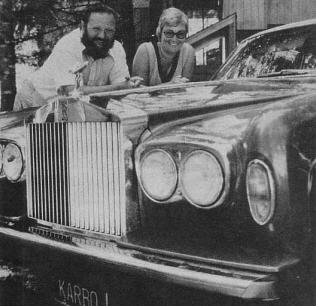
 The following article about Joe Karbo is excerpted from an interview entitled, “The Creators” from the now defunct publication, The Capitalist Reporter, circa 1975.
But was the mail order magnate who penned The Lazy Man’s Way to Riches, himself lazy?
Here’s some rare info about this direct marketing legend.
The wonder is that Joe Karbo works at all anymore. He is the millionaire author, publisher and mail-order advertising salesman of The Lazy Man’s Way to Riches, after all. With more than 400,000 copies of the paperback sold in this country alone at $10 each – versus 50 cents per copy production cost – Karbo can afford to take it easy. Foreign markets now have begun to open up in a big way.
Karbo, 50-year-old son of a Russian Jewish immigrant who worked as a tailor in Los Angeles, now spends about half the year in LA, where he maintains a posh suite of offices overlooking the Pacific to tend to his various ventures that make him $300,000 a year. The rest of the time, he and the family (wife and nine children, although not all the kids still live at home) are at a sumptuous retreat in Washington State, about 50 miles south of Olympia – an ideal place to be, well, lazy.
The trouble is, Karbo doesn’t like being lazy. “The idea of being lazy is appealing, but doing it, or rather not doing anything, is not my idea of a way to pass the time,” he says.
Karbo, who got his start selling in television, sails his boat, rides a bicycle for exercise, and aggressively pursues a career as an actor with amateur companies in the LA area. In fact, when interviewed by Free Enterprise, he was waiting to read for a part in a play scheduled for production by the Funky Cake Company in Newport Beach. He also appeared in stage productions at the well-known Pasadena Playhouse.
“I loved acting,” Karbo admits. “I began in show-biz after all.” For 12 years, he and his wife, Betty, were host and hostess in Los Angeles on what he believes was the nation’s first all-night TV talk show. Under an agreement with the station, the couple used some commercial time to plug products that they themselves had stocked and were selling: vitamins, Christmas ornaments, cosmetics, anything that would sell. To help the slower-moving inventory, Karbo took to mail-order.
The roof fell in 1962, on the day the station was bought by Metromedia. The new management decided to terminate the arrangement, probably fearful that the FCC would take a dim view of it. Karbo suddenly was unemployed, and he, Betty, and their kids lived in a run-down house in a shabby neighborhood. Transportation was a ratty Falcon that Karbo had refinanced.
He owed $50,000, which he didn’t have, and his lawyer suggested that he file for bankruptcy. Karbo disagreed.
Instead, he called his creditors together and told them he couldn’t paid what he owed. “I told them, if you don’t believe I’ve gone bust, force me into bankruptcy. If it turns out I have got a lot stashed away, you’ll recover it and maybe put me in jail. If you believe me, let me do what I do best: sell merchandise. You have my word, I’ll pay you back.” I just didn’t want to feel that every time I got a few dollars ahead that somebody would attach it.”
It took Karbo 90 minutes to persuade his creditors to see things his way and give him nine years to repay what he owed.
After some soul searching and the selling off of some inventory and acquisition of others, Karbo — always a deft hand at ad writing — turned to the how-to book game. It was the decision that led to his fortune.
A year and a half after getting time from his creditors, he dashed off The Power of Money Management, or, How to Get Out of Debt in 90 Minutes Without Borrowing.
Wheeling and dealing through credit from a printer and for newspaper ad space, he sold 100,000 copies and paid off his creditors in less than three years. By then, it was 1965.
Now, Joe Karbo really went to work, penning The Lazy Man’s Way to Riches. It’s a book in which he focuses at the outset on what he terms Dyna/Psych which can be (and has been) described as a mélange of TM (transcendental meditation), positive-thinking, and cybernetics. Part two delves into the tricks and nuances of the mail order game (which might make it alone worth the $10 price per copy). It is now being sold in England and Australia, and is being translated into Japanese. Karbo has diversified since. In addition to his financial publication corporation, he has formed Karbo Advertising, Northwestern Pharmaceuticals, F.P. Schools, and a company to direct international marketing. His fondest love remains publishing, and he maintains a staff of some 40 people to help him look after the business.
“I like to think, for all the help I get, and it’s considerable, that I’m a one man think-tank… with a lot of help from my wife, who spends most of her time in business in figuring out the best way to handle what we’ve got. She’s good at it.” He lights up his favorite cigar, a Bering, and speaks of the future.
He is interested, in addition to acting, in prison reform. He has made visits to San Quentin, and would like to devote more time to improving the conditions in prisons. On credit, he sells his books to the prisoners who ask for them; they can pay him back whenever they can, he says.
“But most of all, I’m a family man. Always have been. And I love the mail order business. Betty and I, now, we’ve got one cooking that I figure will be a real winner – a new book.”
The title?
“Tentatively,” says Joe Karbo, it’s called “The Hell With The Kids, What About You And Me, Baby.”
Wow! This guy is an absolute legend! Joe Karbo is a real inspiration. To have gone right to the brink financially, and then come back bigger and better than ever! Now if that’s not inspirational, I don’t know what is.
At the moment, whenever we turn on the television news or read the newspapers both on and offline, it just seems to be all the doom and gloom of the ‘global financial crisis.’ But to read stories like this about Joe and the hardship he faced – and overcame – it really gives you a sense of, “Gee! Maybe I really can do something today to improve my life and my overall situation.”
That’s why I love the info publishing game. I really do! Opportunities abound for each and every one of us. It doesn’t get much better than this!
We just have to WANT the success for ourselves, and be prepared to take ACTION to make it happen!
Thanks so much for sharing Joe’s story with us!
Hi Ange.
I was at a workshop given by Joe Sugarman about six years ago at the Learning Annex in New York and he told the story about his attempt to promote a Batman Credit Card, only to have the license pulled out from him after he’d invested major time and dollars.
This is the sort of setback that would cause many to throw in the towel for good. But he fought and scraped and was able to pay every lender back. Shortly thereafter, he founded one of the most successful direct response companies in history.
While I was mesmerized by his story of perseverance and true grit, two ladies got up and left. Maybe they were expecting some presentation about magic copywriting secrets.
It turned out that the lesson of perseverance WAS the secret. There was some good copy and marketing info as well.
Lawrence
Lawrence,
What a great GEM !!You really are the master at finding incredible nuggets of information,ads and stories that I find myself lost in the brilliance of the author.
As a big Karbo fan I just realized that I never did read anything about him other than The Lazy Man’s Way……
Thanks for the Holiday Gift.
Mike
I was one of the first buyers of the Lazy Man’s Way to Riches still have the ad out of the La Times Sunday April 1th 1973 april fools day. I did start a mail order business and sold things all over the world on a small scale. Then I ended up in the Salvage and scrap business. I did call him a couple of times we talked. A man who was a printer told me a story about Joe he showed up at his office one day and told him to come look at his new rolls and he said why did you get black and Joe said it’s not black it’s Money Green.
Thanks for the story.
I remember being a kid in the early 70’s and seeing this book advertised in the back of the tabloids that my Grandmother read. I was mesmerized by the title…
I never did get this book until the revised edition came out a few years ago.I remember once when I was about 7 or 8 my stepfather mentioning the book “Think and Grow Rich” which just lit up my head…
The bottom line is SOME people naturally gravitate towards this material..If you have kids give these books to them to see what they will absorb…
Joe and Betty Karbo played the leads in a gem of a comedy produced at Long Beach Community Playhouse in the early 70’s… I am thankful I got to know them, (I had a part in the play too) Their vitality,common sense and talent taught me so much about how to live… they understood people and they understood joy. The money made things possible, but more importantly, they appreciated each other and were creating and exploring every day. Wonderful people!
I live in Belgium Europe and studied in LA in the early 80’s.For me this book was like a bible… Over the years I achieved just about all I could wish for.(without anydiploma!).It’s all about visualizing your goals.In your imagination try to smell it,touch it,see it in detail! Once your subconcious knows what you want,the rest will follow. For me this method has become natural.IF YOU HAVE A VISION,YOU’RE ALREADY HALFWAY THERE…
I have a question for Harry D Moore who posted his comment 13Feb09. Any chance I could get a jpg copy of the ad for Karbo’s book?
Thank you.
I of course have read the Lazy Mans way to Riches as well as the more widely read “Think and Grow Rich”. They were in my fathers library of books that I read…
I personally like the Joe Karbo book best because it just gets to the point of DESCRIBING WHAT YOU WANT, without limit as a singular method of achieving it. This shares the secret of Think and Grow Rich, but in a more direct way.
Karbo also details out his “Super Suggestion”, and “Unconscious Computer” Achievement methods for personal achievement and problem solving.
I actually just re-read the book helping me clarify my 2010 new years goals into what I call the Karbo List Goal Statements.
I combine all of this into my newest guruation, Getting Things Done by David Allen. It really works.
Hey Matt,
Thanks for commenting and great insight. Harnessing the power of the “unconscious computer” — or whatever one chooses to call it — is the key.
Most people are just so conflicted because they never establish what they *really* want.
David Allen is terrific as well.
Cheers,
Lawrence
I bought this book when I was a teenager, over 30 years ago. I have since
come to believe the truth in this book from life experience. To those ready for this material prepare for a leap in evolution.
For the rest of you non-believers……… enjoy it any way. You’ll still learn something valuable.
Tip: The key to happiness is the fun of living.
Enjoy and God bless.
I never rated his adverts. I reckoned that the name was ‘Joker Bo’ and was astonished to find out recently that he was a real person. I expected that anyone who sent off the money would receive a letter back saying that the lazy man’s way to riches was to place adverts saying that you had some great earning secret and wait for the mugsto send their money in.
I just came across the sales letter– The Lazy Man’s Way to Riches
“Most People Are Too Busy Earning a Living To Make Any Money”
I loved the style and the message and was wondering if the book was still available… Not that I am lazy… but I love to read of other people’s successes in business, copy writing, and creating passive income.
Thanks for a great blog post which piqued my curiosity even more. I am sure I will read The Lazy Man’s Way to Riches in the near future.
Ange,
“Now if that’s not inspirational, I don’t know what is.”
Perfect, I agree. I read Joe’s book about 30 years ago – he is completely legendry. I hope that he has done for you what he has done for me.
Ivan,
Ditto, ditto, ditto, all the way.
Heather,
“Most People Are Too Busy Earning a Living To Make Any Money”. This is the entire story in a nut-shell – inspiring stuff.
There are still some copies around. Try the top few: eBay, Amozon, etc.
Joe,
If you find yourself in London, can we go for a beer?
Cheers to all,
Mark
Thanks Mark,
I did get myself a copy of The Lazy Man’s Way to Riches… the one revised by Richard G. Nixon… I was a little concerned that it would not have the original copy by Joe Karbo but it definitely does have the contents of the original book. I got it from the used books on Amazon. Great book so far… I am already seeing results in my life. So glad to have come across this resource.
I bought Lazy Man’s in about 1978. I’ve just re found it and it is the best. He seems to predate all the guys on the block now; Joe Vitale etc. and he is to me the original. Is he still alive? I did hear that he died in the eighties/nineties.
I’m going to read his book at least once a month. If anyone has any copies of his ads or a list of what else he wrote I’d really appreciate any information. Best wishes to you all,
Clive
http://media.wiley.com/product_data/excerpt/8X/04716836/047168368X.pdf
have you all seen this?
C
I’ve read this book a few times over the past 20 years and have had quantum leaps every time.
from using mind power / visualisation to develop concepts and businesses I’ve created many blue prints then just followed the plan.
People have come into my life and things have happened.
11 houses, and a 250k appliance repair biz later and I’ve just started reading it again as well as ron g hollands new book eureka enigma…
what ever the mind of man can concieve and believe he can achieve…
Please all before taking massive action create a dream list and imagine its accomplishment in detail the motivation and action will follow fast if you do it right!
regards
Richard Saupe
Entrepreneur’s Mentor/coach/investor
Hello Richard,
Thanks for commenting on Joe’s timeless book and sharing your kindred philosophies on wealth creation and achieving your dreams.
My friend, Joe Sugarman, knew Joe Karbo fairly well. Karbo attended Sugarman’s landmark copywriting and marketing seminars with the likes of Richard Thalheimer of The Sharper Image, now Richard Solo and many other famous entrepreneurs.
Joe Karbo was a modest family man who wrote one of the most brilliant ads in the space of about an hour. A TV interviewer ambushed him on camera by attacking his work and book and he suffered a fatal heart attack shortly after.
Regs,
Lawrence
Joe would be smoking his pipe and smiling if he saw all the nice things each of you have said about him. I also ran across the original book in the late 70’s and it had a profound effect on my life. Joe’s partner, Richard G. Nixon, who later owned the rights to the book after Joe’s passing wrote the later generations of the book. Richard was a successful entrepreneur in his own right and a great writer. Richard became one of my dearest friends and mentor. A motorcycle accident took Richard’s life a couple of years ago which was a tremendous loss for humanity. Richard’s wife Donna and I have teamed up and will be keeping the legacy alive. We just launched the beginning of a website with a great video interview of Richard. We also have rare footage of Joe and plenty of the original books available (including original hard copy versions of the book). We will be launching a new version of the book including many internet marketing strategies. Anyway, thanks for the kind words for Joe Karbo. It made my night.
Hi,
I was living in a rural area of the Oregon coast when I saw the full page ad in our local newspaper. I believe it was 1980. Good Ad, But WOW, $10.00. Back then I could buy 5 loaves of white ballon bread for a dollar. My husband was making a good wage in the county working at a paper mill with benefits, but on one salary and 2 kids, we were having to pick which bill to pay and which one would have to wait. Sounds like 2010 doesn’t it ? $10.00 was a lot of money to use on something that wasn’t food or a bill…. But with the guarantee that was offered we thought we would take a chance.
As soon as the book arrived, we sat and read the whole thing and were excite about getting started, But we were in the middle of building a house and some how time just slipped away until twelve years ago, when we started selling on the internet. We started applying the things we could remember from the book, to our ad writing, product selection and selling technic. Here it is 30 years later and I am close to retirement. I can’t say I wanted to be a millionaire, I just want to be out of dept and live comfortable and I accomplished that. My home on 4 acres is free and clear, I bought quit a bit of stock, I own a 34 foot motor home, a truck and SUV. I have a good savings and checking account and have NO Bills except health Insurance, power and phone. I feel I owe a lot of my success on the book Lazy Man’s Way To Riches. I would like to buy a case of them and hand them out to folks who are always asking me how I did it. You know, pay if forward. But I don’t know where to buy them. Doesn’t anyone know where I can get case pricing on them ?
Thanks,
Sherry
This is a trip back in time for me. Sometime around the nid 80’s I ordered “The Lazy’s Man’s Way”. Between that and Think and Grow Rich, my life has been a real adventure. I have always valued time and experiance more than money (having both is nice). I had forgotten all about Joe untill, in the course of evaluating some affiliate products to promote, I came across a Chinese guy named Song who exposed me to a guy named Morry and a subliminal program called the Morry Method. Song mentioned that a guy named Joe Karbo had a major,positive influence on him many years ago and now this guy Song has had an effect on me by mentioning Joe which means I am going to have a positive effect on other people – now THAT’S positive. It’s called the silent revalution……not necessarily lazy just relaxed.
Thanks Joe
Steve Kosvic
Thanks for the memory.
Betty Karbo is a dear friend. However, I lost contact with her after she moved to Washington. Our mailing service processed much of the direct mail for Joe. I met Joe after he and Betty married. I don’t know how anyone could forget Joe Karbo.
You’re welcome Elaine. Thanks for the note.
Back in 1974, when I was 19, I ordered Joe Karbo’s, “Lazy Man’s Way to Riches”. At the time I couldn’t decide on my path in life; I was floundering in college, not having the patience or motivation to study hard in any particular discipline. I wanted to make things happen NOW. But the book showed me how to think about what I might really want in life. The book showed me how I could short-cut to success by becoming goal oriented and by marketing a creative idea though mail order. But best of all Joe explained the tricks of success, such as using affirmations and tapping into one’s infinitely powerful “unconscious computer”.
Recently, I’ve been back in the financial struggle. So I started searching the Internet and found a good program I’d like to try. But for the fun of it I thought I’d also Google the ‘Lazy Man’s Way to Riches’, and of course, the Internet, which has everything, served it right up!
http://www.amazon.com/gp/customer-media/product-gallery/1884337015/ref=cm_ciu_pdp_images_0?ie=UTF8&index=0
The instant I saw the cover of the book online, it brought me back in time to the young me being so inspired by this book! The book provided me a set of skills and knowledge that have lasted me a lifetime. I’ll always be indebted to Joe Karbo for his book, “Lazy Man’s Way to Riches”.
@Arthur Schwartz: As per my comment on this site, I purchased the book back in 1974. Unfortunately, my wife threw it out about 10 or 15 years ago. I would love to review this book again as I’m going to try again to use Joe Karbo’s lessons. But I can’t remember exactly what he said about avoiding how you phrase your affirmations, (or perhaps not using them in a particular mental state?). (I know affirmations should be positive not negative, but I don’t think that’s what I’m thinking about; there was something else, or maybe two or three things on that issue.) I would be extremely grateful if you could tell me what Joe mentioned in the book about how to use affirmations correctly.
I bought my original copy of The Lazy Man’s Way To Riches around 1986 from this little antique store in Lawndale, California. But actually, my history with Joe Karbo goes back to 1980, I met him up at a copywriter friend’s publishing company offices in Torrance, California a few months before he died. He was a very very nice guy, I hung on his every word. I have to be very vague, and I am not looking for any attention. I just want to pay homage to a great copywriter, advertiser, and marketing genius, because this is the only real chance that I will have to do it. Meaning a good tribute to a good friend of mine.
Arthur,at 60 yrs of age, I am trying to recover from the latest kicking that life has given me.The first thing I thought of was Joe’s book “Lazy Man’s”.Bought in 1984 it is minus pages 36-53. I wrote out my affirmations last night,started them this morning,all will be well when the sub/computer kicks in.Would you please let me know if I can purchase a new copy of this wonderful book and any information you may have on Joe’s book “The Power of Money Management” which I have not read but may come in handy in my present situation.I live in Andamooka, an opal mining town in Australia.I look forward to your reply.Yours Jack Kerr@Arthur Schwartz:
What a legacy Joe left. So many people acknowledging how much he influenced their lives.Would anyone out there know where I could get a copy of “How to get out of debt in 90 mins without borrowing”.I was curious about it when Joe mentioned it in “Lazy Mans” 27 yrs ago and I would still like to read it. Contact Jack at jaknlyn3@bigpond.com. Thanks.
I just finished reading Joe Karbo’s book and I have to say I am quite impressed. It was very well written, to the point, and has actionable tools that can be put to use. The reality is that most self help books fail in that regard. Most of them have too much fluff and too much theory without anything actionable. Think and grow rich by Napolean Hill was also very good, but maybe not as targeted as Joe’s book.
I have to say that over the years this book has saved my bacon many many times. I am in the middle of another pickle right now – have commenced a business and it really needs sales and marketing funding to take it to the next level. Needless to say Joe’s book is my inspiration.
I do have one question if anyone can give me any assistance – when you have asked the unconscious computer the question to which you have not got the answer any tips on how to “forget about it” as it were.
You have to think about or do something else that captivates you. Impossible to “not think about” a pink elephant. Q.E.D. I dare say. 🙂
It takes guts to face your creditors and tell them what’s in your mind. Most people will try to go underground or lie about their true financial status.
Joe had I CAN DO attitude. Some people call it faith. It is a rare commodity and is lacking in probably 90 out of 100 people.
You can’t succeed in anything in life without it.
I saw the add for Lazy Man’s Way in the back of a few hunting/fishing magazines and decided to risk a few bucks. The book actually changed my life. I used his system and within 6 weeks doubled my wages and vacation time and had moved from the California desert to SE Alaska. I wanted to live where it’s green and I could fish. Joe said that the old saying about opportunity only knocking once is BS. Opportunities present themselves every day. When mine came along I grabbed it. I upped my personal value to well over a million bucks within two years. Just as Joe promised.
I have just re read my ‘Original’ (green) copy of this AWESOME book. I bought it in about 1981 or 82, for about $6 New Zealand dollars. The book is powerful in itself, but for me it was the start of a 30 year ‘self improvement’ journey and a library of books by Bob Proctor, John Assaraf, Catherine Ponder, Dr Joseph Murphy (The Power of your Sub-Concious Mind) Napoleon Hill, Vic Johnson, and many many more.
But still I keep coming back to this one, Thank you Joe!!
I have recently bought some old second hand copy’s to give to my children.
Lloyd M, Hamilton NZ
@KenP:
How did it succeed you?..
Iren from Kiev.
@Lloyd M:
Whose method of visualization is more powerful though, Joe’s or Napoleon’s ? Correct me if I’m wrong, but doesn’t Joe recommend that visualizing the ‘desired’ scenario as having already occurred only be done with personal qualities that we aspire to have, and not with tangible possessions, for the reason that if we imagined ourselves already with a million in cash, our subconscious, unaware of the difference between reality and what is vividly imagined, would consider that we already possess the money and stop trying to help us to help us get the money? (Napoleon on the other hand recommends the “imagine its already yours” philosophy for everything including specific money amounts.)
I bought this back in 1986 I used it to good effect and achieved more in my life than ever before, however I found it again after it had been in the loft for many years as I’m in need to revisit it and help myself again.
Problem is nowadays I have less time and many more distractions to be able to concentrate on the Daily Declarations without being interrupted, does anyone have any tips to combat this?
one way is to record the the Daily Declarations and play it over and over on a low volume while you sleep
Thanks Steve
That’s a great idea, I’ll see if I can find a microphone and record it in MP3.
@DionysiouA
No, he didn’t say that. He said don’t pick material goals for your super suggestion sessions because you are trying to connect directly with your subconscious at these times and your subconscious will believe that you have already achieved the goals.
Reading the daily affirmations and visualising yourself as having achieved material goal is different because your conscious mind will filter the information before it sinks into the subconscious. That’s the theory anyway.
I loved Joe Karbo’s book and the Society of Partners.
After getting a response from someone who wanted to purchase real estate property in the United States from Canada, it was quite easy to walk on over to my former congressman’s house and to then present him that letter.
I understood that Joe died, and then his wife sold the business, but those who got didn’t have the needed spark, to get everyone as excited as he was fully capable of doing.
To Jack – Someone has published Joe’s old book here –> https://www.thelazymanshop.com/products/copy-of-joe-karbos-power-of-money-management-pdf-ebook
Bought and read the original version a couple of years ago, but wasn’t consistent with my daily declarations. Working on the consistency part now. 😉
I lived in LA from 1949 to 1977. Insomniac that I am I watched Joe and Betty on their little noticed but ground breaking talk show. Wise Joe and everybody’s Mom Betty were real people and made all feel welcome. The show I remember most was a surprise visit by the actor Nick Adams. He had been off the air for awhile and appeared to being trying to get his face on the screen and not be forgotten. Sadly he died of an OD a while later. One more victim of tinsel town. Except for reruns of the Rebel that was his last time on TV. I thought at the time what a sad and unnecessary waste of a young , handsome, talented and thoroughly likeable man.
Wow I bought the book around 1986 from a UK Sunday Newspaper where the full page Ad was running. I bought the book, and devoured the principles. Some weird things have happened over the years when ‘handing over my desires to the subconscious’; I wanted a new plane type and needed £10,000 to fund it. I was going to extend the mortgage – and then 2 months later, a friend rings to say there’s a £10,000 project that’s come up at a Global company and did I want it? Definitely! It paid the difference! Truly amazing and inspirational. I just found that Betty died in 2019 and there’s pictures of Joe and everyone here >> https://www.dignitymemorial.com/obituaries/westminster-ca/elizabeth-karbo-8187395#
Hello Paul!
Many thanks for sharing your experience with LMWTR.
I’ve seen so many comments like this over the years.
Perhaps, I should stop being so lazy and at last get myself a copy.
Cheers,
Lawrence