He went from the Downtown comedy clubs to the hallowed halls of the J. Walter Thompson ad agency.
He started by writing ads and followed his mentor, James Patterson, into the world of writing mysteries, becoming an advertising creative director along the way.
Who is he?
He’s mystery writer, copywriter, screenplay writer, creative director, improvisational comedian and now children’s book author, Chris Grabenstein, that’s who.
And I was fortunate enough to be able to interview him last month.
How has Chris been able to achieve so much in so many different areas?
It’s really no mystery.
Chris shares over 30 years worth of strategies for succeeding in the world of advertising and fiction, attention getting communication and winning productivity habits.
Here’s some of the nuggets you’ll glean from this interview:
- How a cream pie in the face can earn you millions
- Why there are no losers in advertising…only unemployment
- How to “leave out the part that readers tend to skip”
- Why improvisational comedians outperform door-to-door salesman in advertising…sorry Claude Hopkins
- Why no one cares about your product (or if you spent a year on R&D)
- A foolproof system fiction writers can use to hold themselves accountable
- Why there’s always another winning idea…even after everyone else has given up
- Why you must EARN people’s attention in advertising (or any kind of writing)
- The copywriter-mystery writer connection
Filed under Blog by
How do you really know if you’re a copywriter and not just someone who dabbles writing ads?
It’s pretty easy to tell.
Little things like meals (and showers) cease to have the same importance when you’re in the heat of writing an ad.
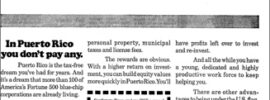
David Ogilvy recounts spending ten days at home doing nothing else but writing this ad for Puerto Rican Economic Development in 1955.More on David Ogilvy and the 10 Day Home Confinement Ad
Filed under Ogilvy & Mather Direct Swipe File by
Almost everyone is interested in making more money.
If you can legitimately show others how to make more money, you’ll never want for money yourself.
This is especially so in recessionary times.
George Haylings slept in his car while pyramiding his classified advertising profits during the Great Depression.
Joe Karbo and Ernest Weckesser wrote breakthrough biz-op ads which ran in the Wall Street Journal at the height of the 1970’s recession. Such ads never appeared in The Journal before. Boardroom launched its business development classic, I-Power,More on Recession Beater #7: The Coming Business Opportunity Explosion
Filed under Eugene Schwartz Copywriting Swipe File, Recession Beaters by
Two Money Disasters That Could Strike on Saturday
(one of them could happen sooner!)
18 defensive investments and six complete investment plans that investment consultant, Harry Browne, believes will make money for you whether or not these disasters strike.
WHILE MILLIONS of Americans were jazz-dancing their way into bankruptcy during the 20s, a smaller number were preparing for a rainy day. And rain it did — for 10 years.
But for the farsighted few who knew what they had to do early in 1929 (take their cash out of the banks before it was too late…sell short…provide for themselves while the going was good) – for these sensible people, the depression wasn’t all that bad. Indeed, some of them made fortunes!
Well, Harry Browne says the signs are here again. (The signs are nothing more than a shrewd assembly of today’s headlines). If you were shaken by the financial events of the past few months, this book will offer you little solace. Browne sees worse things on the horizon. But he tells you exactly how to preserve your assets and actually multiply them in the darkest hours.
Plain Language Advice Any Layman Can Understand – and Act On
Because an investor (or anyone with just a savings or a checking account) cannot survive a devaluation without a solid understanding of the nature of our money system and just what happens to it in devaluation, Harry Browne spells it out in clear, everyday language free of technical jargon. He calls on his vast knowledge of economics, history, crowd psychology, and the way a welfare state misbehaves in a time of crisis, to show you that we may expect several economic cataclysms before the devaluation that is bound to come.
And he shows you what the effect will be on you, your job, or business, your personal finances, your family… shows you what your plan should be in each crisis — but always in light of the devaluation that is now inevitable:
- Continued inflation. What will have to happen to the supply of paper money if the present spiral continues. What this means to you. What steps to take right now, while there is time. What drastic measures you should avoid.
- Short-term recession. Popular hedges. What will happen to prices. Effects upon business. What this means to you. Certain profit sources that may remain intact.
- Depression. Will the next depression be deeper and longer than the last one? What will happen to personal credit? What this means to you. The collapse of the welfare state. Little known protective measures.
- Run away inflation. Guidelines to use if paper money becomes totally worthless. The only way out. A precaution you must start to think about today.
The very thought of these crippling events can numb the most determined investor, but those who lose from devaluation will be those do nothing, or who accept conventional investment advice. Those who come out ahead will be those who are not afraid to stand apart from the crowd. Who have taken the trouble NOW to understand why devaluation makes investing and protecting your money a whole new ball game.
How To Achieve Your Financial Goals — in Spite of Devaluation…And Because of It!
While unwily investors around you are losing their shirts because of devaluation, there is absolutely no reason for you to share in their plight. That’s why we call How You Can Profit From the Coming Devaluation a “selfish” book.
Browne’s sure-footed plan of defense and offense consists of six investments designed to give you:
- Good growth, not necessarily maximum growth, in assets during the present cycle.
- Protection, liquidity, flexibility, and buying power in the next depression.
- Safety and rebuilding power if we have a runaway inflation.
- An excellent profit from the devaluation itself.
- Peace of mind no matter what happens.
This 6 investment investment program can work for you, whether you can write a check for $5,000 or $100,000. Indeed, Browne breaks down the investment opportunities according to your present assets, shows you exactly how much to put into each of these investments.
- Cash and dollars – how much you need on hand, where to keep it, what to do about your checking account. Where not to keep a savings account.
- Swiss Francs. Their special strengths. How to convert your dollars to Swiss Francs easily. How to open a Swiss Franc bank account. Addresses and procedures. Laws.
- Silver coins. Numismatic value. Spending money. How much to keep in silver coins. Melting. Where to store. Where to buy.
- Silver bullion. How to use leverage to buy. Who will sell your bullion.
- Gold stocks. How this will profit you through three economic crises.
- Retreats. Why you need one. How to acquire a safe one.
Risk Free Examination
Mail $5.95 with coupon below for How You Can Profit From the Coming Devaluation. Return it within 30 days if not pleased for full refund plus extra money to reimburse you for return postage. Mail to your bookseller or: Arlington House Publishers, 81 Centre Ave., New Rochelle, New York 10801. (or available on Amazon.com)
Filed under Copywriting Swipe File, Financial Advertising by

How do you sell a high priced, around-the-world adventure, including the North and South Poles, on a shoestring budget?
Simple.
Lead with a great idea, then persuade the world’s best mailing list expert and copy talent to jump on board.
This seven-page sales letter was mailed in 1968 on a budget of $5,000 to owners of yachts, Arabian horse breeders and owners of private two-engine airplanes. The price for this round the world voyage was $10,000 or $61,000 in 2009 dollars.
The promo was a smashing success and pulled in 72 respondents who ponied up $10k each.
Dick Benson was the “grumpy genius” behind the marketing and Hank Burnett wrote the copy.More on The Admiral Byrd Socitey Sales Letter (Copywriter: Hank Burnett)
Filed under Copywriting Swipe File by
Here’s a 1960’s space ad Leo Burnett wrote for Readers Digest.
It’s an effort typical of his style: simple, direct and free of affectation.
Interestingly, David Ogilvy penned a similar ad promoting the Digest. In both cases, the main objection these legendary writers countered in their copy was that the Digest was for low-brows. Besides the fact that these agency founders went out on a limb for the Digest, they make convincing arguments for its content.
Click here for a PDF version of “Magazine with a Mission.”
Filed under Copywriting Swipe File by
How can you get a Nobel Prize Winner to endorse your product or service?
Believe it or not, it can be really quite simple.
And one of the best places to take a cue from is top flight direct response companies who know the importance of pairing promise and proof.
So with that in mind, I’ll swipe Ken McCarthy’s equation: Traffic + Conversion = Profits for:
Promise + Proof = Profits
See, without superb proof mechanisms, the loud promises just get drowned out. Amazingly, most marketers never catch on to this fact. And that’s good news for us!
Look at the above headline for the colon cleansing product, Flora Source.More on Promise + Proof = Profits
Filed under Advertising Headlines, Copywriting Swipe File by

Leo Dug Hard to Identify the Inherent Drama
in Everyday Things
(The following interview arrived in my inbox one Saturday morning, courtesy of one of the most formidable marketers in my rolodex. He made his bones and shuns the neon lights…for now. He clipped this article a long while ago and has no idea of the source. The underlinings are his.)
Leo Burnett was obsessed with finding visual triggers that could effectively circumvent consumers’ critical thought.
Through the Thought Force of Symbols, he said, “we absorb it through our pores, without knowing we do so”
Television, he asserted, “is the strongest drug we’ve ever had to dish out.”
He dug hard to identify the inherent drama that resided within a product through the conscious use of “earthy vernacular” imagery
Here are highlighted excerpts from an Interview with this legendary Ad Man from the Golden Age of Advertising.
Well, one of the things I wanted to ask you, Mr. Burnett – touching on what you’ve said – did you find writing ad copy more difficult than writing newspaper copy?
More on Leo Burnett, a Little Giant from the Golden Age of Advertising
Filed under Blog by
Most direct marketers think ‘Fortune Fives’ are bloated behemoths who couldn’t pull off a successful direct response promo to save their corporate lives.
Not so.
Here’s a memorable 1,304 word display ad from International Paper from nearly thirty years ago.
Were we all to “read better, write better and communicate better,” as the ad urges us, I suppose we’d be consuming even more paper.
Nevertheless, you could easily transpose the Learning Company for International Paper, add an order coupon, and you’d have a top flight direct response ad today.More on Fortune 500 Direct Response Advertising: “How To Improve Your Vocabulary”
Filed under Copywriting Swipe File by
Gary Halbert is remembered for a lot of things.
* The writer of the most mailed sales letter in history: “The Coat of Arms Letter.”
* A gifted and profound teacher who’s probably influenced more direct response practitioners today than any other.
* A pirate in business. Especially in later years.
One of the things he’s not as well known for, yet was a world class master of, is the space ad.
Gary took a perverse pleasure in coming up with some of the weirdest pseudonyms in his early display ads.
When I saw him at Gary Bencivenga’s seminar in 2005, I complimented him on them and we talked about these early ads.
(Leave a brief comment if you are interested in some of these early ads.)
This one was written 21 years ago for Tova Borgnine and is a textbook example of a direct response ad for a beauty product.
Though the “reason why” and U.S.P are compellingly stated in this concise ad, the biggest take away however, is the response boosting nuance in the last paragraph.
If you are in the Southern California Area, you may pick up the product at 8920 Wilshire Boulevard, Beverly Hills, California, between the hours of 8:30 to 5:30 Monday to Friday.
In Gary’s opinion, this one little closing paragraph boosted response to this ad by at least 50%.
Why?
There were no customer lines on Wilshire Boulevard. Almost no one showed up to pick up the product in person.
What this paragraph did was strengthen the association between the product and it’s place of origin — Beverly Hills — a place that’s loaded with connotations of wealth, beauty and luxury.
More importantly, it persuaded even the most skittish prospect that, yes, this is a bona fide product from a legitimate company…so much so that they invite you to their Beverly Hills location to pick it up.
Devilishly reassuring.
Here is a full page PDF of: “Amazing New Formula from Beverly Hills Lets You Look Years Younger.”
Filed under Gary Halbert Copywriting Swipe File by