This has got more potential than anything I’ve seen in a while.
If you do any form of email marketing, this is something you’ll want to test asap because now you can embed YouTube videos that play directly in your customers’ Gmail Inboxes.
No need for your customers to click on an outbound link or take an intermediate step, they just click on the play button and your video plays immediately.
So, lets say you intend to send your customers to a long scroller of a sales letter. You can now record a two-minute video with your webcam, upload the video to YouTube, then include the Youtube URL in your email broadcast.
The upshot is, you can give your customers a quick overview with a call to action at the end of the video before they click on the target link in your email message. This can make a world of difference when your customers arrive on your sales page.
And with Gmail possessing over 100 million users, plus being the fastest growing email service, this isn’t something to ignore.
You don’t need fancy production values or be a polished speaker to do this. If you screw up, as I did several times before recording this, you just do it over. Another benefit of embedding videos that play in your customers’ Inboxes is you establish you’re a real person. It’s hard to do enough of that.
No doubt, we’ll be seeing a lot of YouTube content sent directly into our email Inboxes in the near future. God help us when the spammers catch on!
Filed under Blog by
On Tuesday, February 16th, I had the chance to chat with author and former Ogilvy & Mather CEO, Ken Roman, at the invitation of my friend Byrne Hobart.
What did we talk about?
Byrne and I, of course, grilled him on his latest book, The King of Madison Avenue: David Ogilvy and the Making of Modern Advertising.
Like a typical, turbo-charged CEO, Ken called into the conference line from the back of a yellow cab cruising through the snow covered streets of Manhattan.
This is a book that tells the rest of the story about David Ogilvy, the most famous advertising man in the world, from someone who worked shoulder-to-shoulder with him for decades.
More than just a book about Ogilvy, The King of Madison Avenue reveals the evolution of modern direct response advertising in the 20th Century.
Kenneth Roman has co-authored several acclaimed books including: “How To Advertise” and “Writing That Works” and he maintains an active speaking schedule.
Byrne Hobart works for the web development company, Blue Fountain Media in New York City.
The highlights are mine.
Lawrence Bernstein: Hello, this is Lawrence Bernstein and today I have the privilege of being on the line with Kenneth Roman and Byrne Hobart. Kenneth Roman is the former CEO of Ogilvy and Mather and the co-author of How to Advertise and Writing That Work. Today, we are going to be talking to him about his most recent book, The King of Madison Avenue, David Ogilvy and the Making of Modern Advertising. And we are also on the line with Byrne Hobart of Blue Fountain Media. Blue Fountain Media is a boutique website development and online marketing firm located in New York and Byrne is a rare expert bridging both new media and classic direct response advertising — the kind that David Ogilvy helped to make famous.
Kenneth and Byrne, welcome to the call.
Kenneth Roman: Thank you very much, can I also add that Blue Fountain designed my website which is how I got involved in this whole thing and they did a terrific job for me.
Lawrence Bernstein: Well, that’s great. Thank you. I thought before we just dive into a couple of questions, we might just preface it by letting you tell us, Kenneth, a little bit about your work at present day.
Kenneth Roman: Well, I’m out spending a lot of time talking about the book. I just have done some work on the paperback edition, which is coming out in this spring and I’m thinking about what I’m going to do next.
Lawrence Bernstein: Do you want to lead with a question then, Byrne, and then I’ll follow up?
Byrne Hobart: Sure, so as I was reading the book, I noticed that Ogilvy goes back between the soft sell and hard sell traditions. Do you know which one he ended up settling on?
Kenneth Roman: The idea of soft sell verus hard sell is one that a lot of people in the business reject a little bit. David Ogilvy believed in only one thing and he really believed this passionately, which is, in selling, he did some of the classiest, most interesting advertising that’s ever been done from historic edit, but as he was proud of saying, “Every ad I ever wrote sold.”More on Interview With Former Ogilvy & Mather CEO, Ken Roman
Filed under Blog by
At first, I thought my friend, Karl Blanks, got a degree in rocket science just so he could make room silencing jokes about it.
Now, after seeing an article in CNN Money entitled, “Google’s favored rocket scientist?,” it’s clear there’s evergreen PR value in his degree…besides the added rocket fuel he brings to the marketing table as a Cambridge trained rocket engineer.
But really, Karl’s success isn’t rocket science. (Last rocket science joke, I promise.)
Last year, he related the story of being hired by large corporation to find out why people bought xyz widget.
So what did he do?
He went to a remote country fair — heck, it looked like the Scottish highlands – and stood at a concession table for 6 hours asking prospects and customers a series of core question about the product: how they felt about it, what made them buy it over competing products, would they pay more for it, etc.
By the time he was done, he knew more about that widget than the widget manufacturer did and was able to get down to site optimization with as close to perfect information as any marketer can hope for.
He and his partner, Ben Jesson, just put together a report on “How we increased the conversion rate of Voices.com by over 400%.” In this fast reading report, they mention four things that gave them quick wins during their conversion rate overhaul.
Filed under Blog by
Whenever I interview a prospective copywriting or consulting client, one of the first questions I usually ask is: “who’s this product for?”
And more often than I’d like to hear, I get the answer: “it’s for everyone.”
Experience has taught me to defer on such projects because the prospective client has no idea who his or her target market is. And that signals there’s usually a basket of oversights and problems in addition to this biggie.
Conversely, when you ask the question, “who’s this product for?” and get an answer like, “it’s for single executive women who live in Tribecca, have aspirations to be a managing director and spend their summer weekends in the Hamptons,” then this is as green as lights get.
These clients not only know who their target market is but they’ve likely designed the product with this demographic in mind.
Does this mean there are no products with “everyone” as the target audience.
Well, yes and no.More on Copywriting: Headline Nightmares
Filed under Advertising Headlines by
If you’ve heard the story of a young Gene Schwartz working one day in the mail room and a few short years later becoming a mail order millionaire, then here is an interesting ad.
It was written in 1975 by the man who showed Gene the ropes in the early 50’s, Cecil Hoge, the founder and president of the Huber Hoge, Inc.
The promise of this ad is essentially a stone’s throw away from the internet marketing pitches that plague us today…but there’s a key difference.
Most of those offers lack the sophistication of even hinting that they might not be for you.
Not here.
How many internet marketing offers actually state that you can “lose plenty?”
Brutally refreshing.
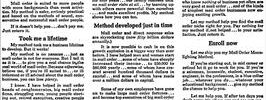
Took Me a Lifetime.
My method took me a business lifetime to develop. But it works!
My method is no panacea…just as mail order is not for everyone. But I can tell it as it is…to give you a real chance in the real world of mail order. Because otherwise, believe me, if you are ill suited to…or ill informed or ill advised about the mail order business, you can lose plenty.
Here is a readable image of Mail Order Moonlighting.
Filed under Copywriting Swipe File by
One of the best pieces of advice about the role of integrity in copywriting and marketing comes from Eugene Schwartz. There are bountiful examples he practiced as he preached.
Gene said:
“[The copywriter] must never write an ad just to please the client…or to make money…or meet a deadline…and never, never write an ad for a bad product.”
Turning a deaf ear to critics should be added to this list.More on Do You Have the Courage to Break Conventional Thinking?
Filed under Eugene Schwartz Copywriting Swipe File by
This is the tried-and-tested lead generation ad for The Institute of Children’s Literature.
It’s been going strong for over 30 years in both space and direct mail.
This space ad is the latest incarnation of the piece written by legendary copywriter, Malcom Decker.
If you’re a copy connoisseur, you’ll want to download the PDF by clicking on the thumb on the left and read it at your leisure.
Two of the main take-aways are the magic of the word “Institute” which has been used by savvy direct marketers since the 1920’s and the response-driving power of the “aptitude test.”
You know everbody “gets in.” Don’t you?
In case you missed the first piece on Swiping Successful Business Models, here it is.
Filed under Copywriting Swipe File by
There’s been a lot written on Bruce Barton, so I figured I’d add a small piece to the pile.
Bruce Barton packed a lot into one lifetime. He was…
* Chairman and co-founder of one of the world’s largest advertising agencies, BBD&O
* Publicist, magazine editor and fiction writer
* United States Congressman and a prominent rival of FDR and the New Deal. (FDR singled out Barton and two other Republican foes in the fantasy firm of “Martin, Barton & Fish.”)
* A source of countless cling-to-the-memory quotes and catchy phrases (like: “If advertising has flaws, so has marriage.”)
* And…one heck of a copywriter.
A donation letter he penned to 24 wealthy men in 1925, requesting $1,000, received a 100% response rate.More on Bruce Barton: The Advertising Copywriter
Filed under Copywriting Swipe File by
18-year-old copywriter, Lillian Eichler, was working for the New York Ad Agency of Ruthrauff & Ryan.
Her first problem:
To move 1,000 dusty copies of the pre-1900 Encyclopedia of Etiquette, written by Eleanor Holt, which were sitting on Doubleday’s shelves.
Her second problem:
Most of the 1,000 copies were returned after the 5-day-trial period. Respondents weren’t thrilled with the ludicrously archaic text and pictures.
Lillian’s ad copy had emptied the shelves in mere days.
Doubleday, being the smart publishers they were, realized if Lillian’s ad copy could move 19th-Century books, she was probably gifted enough to rewrite the book herself and have a second go at advertising it.
The result:
Lillian’s revamped effort, The Book of Etiquette, sold two million copies at $2 each, in the course of two years, resulting in $2.5 million in net profits.
Nearly $26 million in 2008 dollars.
All inspired by the wish to unload a roomful of dusty books…and the vision of a young copywriter.
Reading this copy in 2008, it’s stunning to realize it came from the pen of an 18-year-old girl, nearly 90 years ago.
Filed under Copywriting Swipe File by
This ad was was written by Philip W. Lennen in 1924 and effectively launched the ad agency Lennen & Mitchell.
Lennen credited this ad in part with taking the agency from zero in billings in 1924 to $12,000,000 by 1948.
Lennen described the ad as follows:
“The effect of the advertisement was electric. It secured us leads on two very important accounts, which are still in our house today.”
Here’s an interesting comment on “conference copy.”
“Conference copy seldom holds a candle to the job done by the solitary worker who shuts himself up with his problem — and lives with it until he licks it.”
Filed under Copywriting Swipe File by